
Quick answer
Local ranking is a matching and trust problem, not one hidden trick.
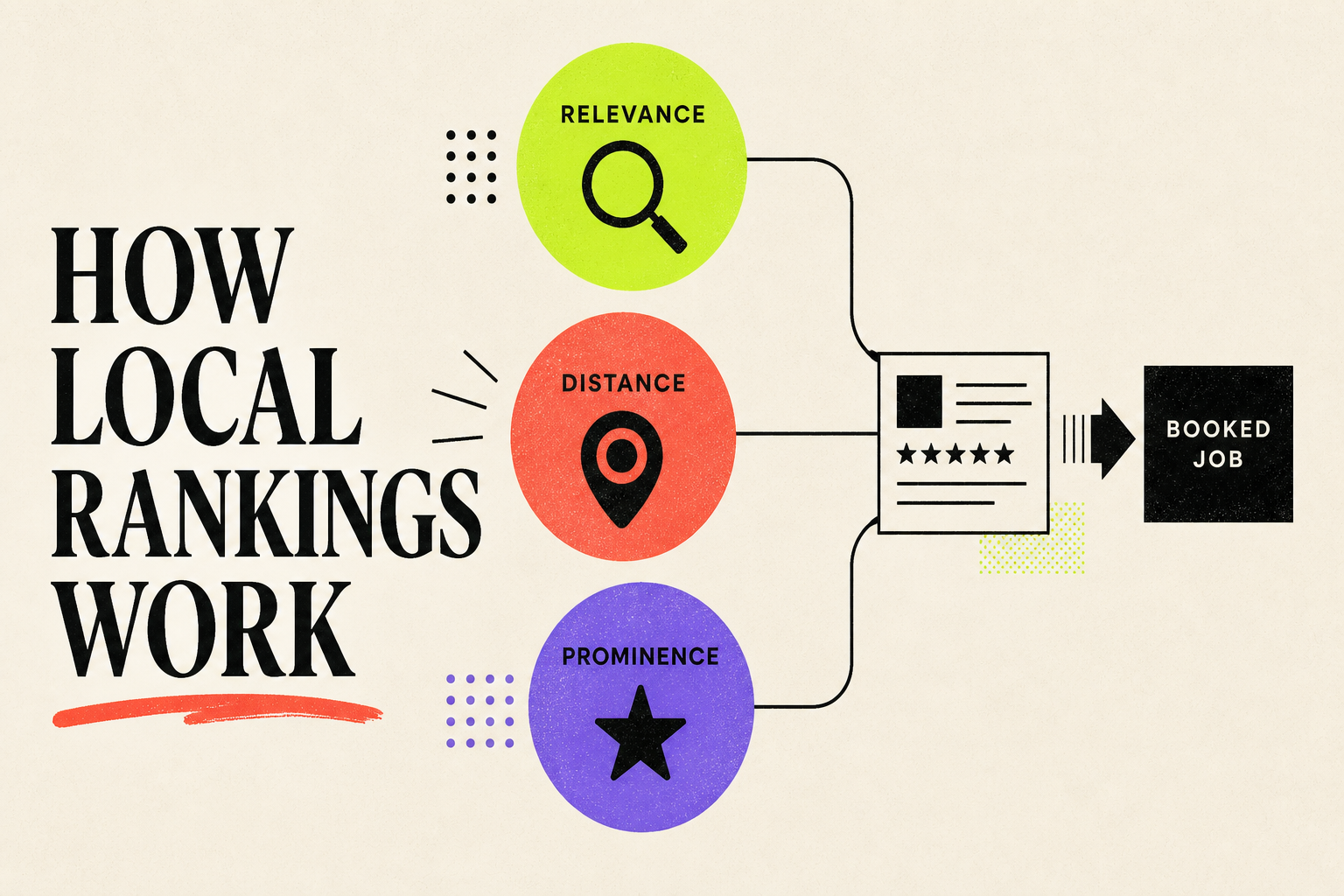
Google says local results are mainly based on relevance, distance and prominence. A business improves its position by becoming a clearer match for the search, maintaining accurate and complete information, building real-world and online prominence, supporting the profile with a useful website, and making it easy for customers to take the next step. Distance cannot be optimized away, so progress should be measured across the real service area rather than with one ranking screenshot.
Local SEO involves two connected result systems
A local customer may see a map pack, a Google Business Profile, ordinary website results, or a mixture of them. Maps visibility and organic website visibility are not identical, but they support one another because both depend on Google understanding the business, the service, the location and the quality of the available evidence.
Think of the Google Business Profile as the verified business card and the website as the fuller explanation. The profile can show the category, hours, service area, reviews, photos and contact actions. The website can explain individual services, answer questions, provide proof and help the visitor decide whether to call or book.
A business can therefore be visible on Maps but have a weak website, or have useful organic pages while appearing inconsistently across the map. A proper baseline checks both systems and then follows the customer through to an enquiry or appointment.
- Maps and the local pack answer: which nearby businesses appear relevant and prominent for this search?
- Organic results answer: which pages provide the most useful and reliable response?
- The booking path answers: can the customer understand, trust and contact this business without friction?
1. Relevance: are you a clear match for the search?
Google describes relevance as how well a Business Profile matches what someone is searching for. Complete and detailed business information helps the system understand the business and connect it with relevant searches.
For a local service company, relevance starts with the correct primary category and accurate supporting categories. It continues through the listed services, business description, website landing page and the actual content customers can read. These elements should tell one consistent story.
Relevance is not created by repeating a city and keyword in every sentence. It comes from clearly explaining what the business does, which situations it solves, who it serves and where the service is genuinely available.
- Choose the most specific accurate primary category.
- List real services using the language customers understand.
- Link the profile to a page that supports the same service promise.
- Create focused service pages when the customer needs a substantial explanation.
- Keep business facts consistent between the profile, website and important directories.
What can move: visibility for searches that genuinely match the business. What cannot be assumed: that adding a keyword automatically produces a top position.
2. Distance: where is the customer searching from?
Distance is the separation between the business and the person searching, or the location named in the query. When the customer does not specify a location, Google uses what it knows about that person's location.
This is why two people can search for the same service at the same time and receive different local results. It is also why a business may rank well around its address but become less visible farther across the city.
A service-area setting does not create a new physical location in every selected town. It tells customers where the company works. Useful location pages, local proof and strong service information can improve relevance and customer confidence, but they do not erase physical distance.
- Measure from several points across the actual market.
- Separate weak relevance from normal proximity effects.
- Avoid judging performance from searches repeatedly made at the office.
- Use genuine local evidence instead of cloning one city page many times.
Distance is partly outside the business's control. The useful question is where visibility is commercially adequate, not whether the company is number one everywhere.
3. Prominence: is the business known and trusted?
Google uses prominence to describe how well known a business is. Its official guidance connects prominence with information found across the web, including links, articles, directories and reviews. Well-known real-world places can also be prominent because the search system tries to reflect offline importance.
For an ordinary local company, prominence is accumulated through genuine customer experiences and credible local relationships. Reviews, relevant links, consistent citations, useful coverage, memberships, suppliers, partners and original resources can all strengthen the evidence around the business.
Prominence should not be confused with buying hundreds of weak directory listings or unrelated links. The strongest signals normally make sense to a customer even if search engines did not exist.
- Ask eligible customers for honest reviews through a consistent process.
- Respond helpfully and learn from recurring feedback themes.
- Correct important directory records and remove harmful inconsistencies.
- Earn locally relevant mentions through real relationships and useful work.
- Publish original information that another organization would reasonably reference.
The website supports ranking, trust and conversion
A website does more than supply keywords. It gives Google and customers an owned source for understanding the business. Focused service pages can clarify what is offered. Evidence such as project details, staff experience, credentials, customer questions and service boundaries can reduce uncertainty.
Technical foundations also matter. Important pages must be crawlable and indexable, mobile visitors need a stable and responsive experience, and the call or form route must work. LocalBusiness structured data can help describe business details in a standardized format, but it is not a shortcut that replaces useful content.
The business outcome occurs after the ranking. If the visitor lands on a slow, confusing or generic page, visibility may produce impressions without useful enquiries. That is why Book More Jobs treats discovery, credibility and conversion as one connected path.
Example: an emergency plumber with uneven visibility
Imagine a plumber whose office is on the west side of a city. The company appears strongly for emergency-plumber searches near the office but is rarely visible on the east side. One screenshot from the office makes performance look excellent, while a wider map shows the commercial gap.
The audit finds that distance explains part of the pattern. It also finds controllable gaps: the primary category is broad, emergency plumbing is missing from the services, the linked homepage barely mentions emergency response, recent reviews focus on remodeling rather than urgent work, and local organizations link to competitors instead.
The sensible plan is not to promise first position across the city. It is to align the profile and emergency-service page, improve the mobile contact path, collect genuine feedback after eligible urgent jobs, build relevant local authority and measure coverage again from the same points. Calls and booked emergency work are recorded alongside visibility.
Measure movement, not a single ranking
Local rankings change with location, query, time, competition and the searcher's context. Average position can be useful as a trend, but it should not become the only business score.
Google Search Console reports impressions, clicks, click-through rate and query data for website results. Business Profile performance and carefully controlled call, form and booking records can extend the picture. The goal is to understand whether more qualified customers are discovering the business and successfully taking action.
- Day 0: record profile facts, website condition, visibility samples and lead baselines.
- Day 14: confirm indexing, implemented changes and early visibility movement.
- Day 30: review impressions, queries, coverage, calls and forms.
- Day 60: compare service-level visibility with qualified enquiries.
- Day 90: assess appointments, completed jobs, delivery effort and the next constraint.
Common mistakes to avoid
Most weak local programs are not missing one secret. They are either measuring the wrong thing, changing many disconnected elements without a baseline, or producing pages and listings at scale without adding useful evidence.
- Treating the business name as a place to add unsupported keywords.
- Assuming selected service areas create ranking locations.
- Creating near-identical city pages with no local usefulness.
- Buying bulk links, reviews or citations instead of building credibility.
- Reporting rankings without calls, forms, appointments or jobs.
- Publishing large amounts of generic AI content primarily to manipulate search visibility.
What to check this week
Eight useful checks before buying another SEO package
- 01
Search from several points across the real service area and save the baseline.
- 02
Confirm the Business Profile is verified, complete and factually accurate.
- 03
Check whether the primary category precisely describes the core business.
- 04
Compare the profile's services with the linked website page.
- 05
Review the recency, detail and themes of genuine customer reviews.
- 06
Check important directory records, local mentions and relevant links.
- 07
Test the website's mobile call, form or booking route.
- 08
Record impressions, enquiries, appointments and completed work separately.
Primary sources
Documentation used for this guide
- Google: Tips to improve your local ranking
- Google: Manage your business category
- Google: Creating helpful, reliable, people-first content
- Google: Spam policies for web search
- Google: LocalBusiness structured data
- Google Search Console: Performance report tasks
Reviewed August 9, 2026. Google can update its documentation and systems, so this guide should be reviewed periodically.